

How much does auto insurance cost in Michigan?
Your actual premium depends on your driving history, age, vehicle, coverage level, and ZIP code within Michigan. Rates can vary 40-50% or more between the cheapest and most expensive carriers for the same driver — which is why comparing quotes is essential.
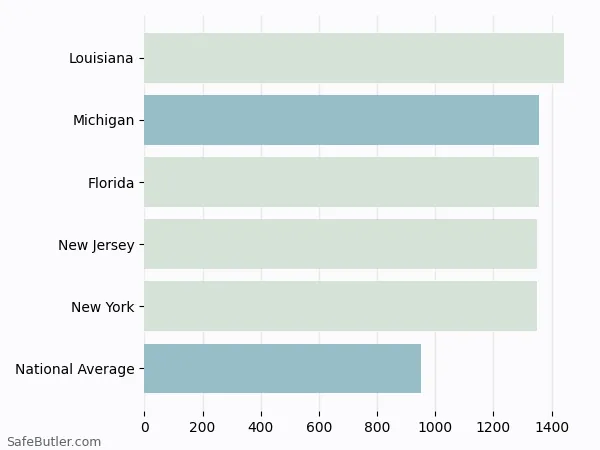
Michigan auto insurance minimum requirements
Michigan historically had the most expensive auto insurance in the country due to its unique unlimited personal injury protection (PIP) requirement. A 2020 reform law allows drivers to choose their PIP coverage level — from unlimited to $50,000 — which has brought premiums down for many drivers. Michigan also has the highest uninsured motorist rate in the country.
Every driver in Michigan is required to carry at minimum the following coverage. Driving without insurance is illegal and can result in license suspension, fines, and financial liability for any accident you cause.
| Coverage Type | Michigan Minimum | Recommended |
|---|---|---|
| Bodily Injury Liability (per person) | $50,000 | $100,000 |
| Bodily Injury Liability (per accident) | $100,000 | $300,000 |
| Property Damage Liability | $10,000 | $100,000 |
| Personal Injury Protection (PIP) | Required (no-fault state) | Review your limits |
The state minimums are a legal starting point — not an adequate protection strategy. A serious accident with injuries and multiple vehicles can generate losses far exceeding these limits. Most financial advisors recommend carrying 100/300/100 as a minimum for anyone with assets to protect.
Important for Michigan drivers: Under Michigan's 2020 reform, you can choose your PIP level: unlimited, $500,000, $250,000, $50,000 (if you have Medicare Part A and B), or opt out if you have qualified health insurance. Choosing a lower PIP level can substantially reduce your premium — but evaluate your health insurance coverage carefully before opting down.
Is Michigan a no-fault or at-fault state?
Michigan is a no-fault state. In a no-fault system, your own insurance policy pays your medical bills and lost wages after an accident regardless of who caused it, up to your Personal Injury Protection (PIP) policy limits. You do not need to prove the other driver was at fault to receive payment for your medical costs.
The trade-off in a no-fault state: your right to sue the at-fault driver for pain and suffering is restricted unless your injuries meet Michigan's "serious injury threshold" — typically defined as permanent injury, significant disfigurement, or fractures. If your injuries qualify, you can step outside the no-fault system and pursue a tort claim against the at-fault driver.
What this means for your coverage choices
- PIP limits matter. Make sure your PIP coverage is high enough to cover potential medical bills. The state minimum may not be sufficient for a serious accident.
- UM/UIM coverage is still important. Even in a no-fault state, uninsured motorist coverage protects you when an uninsured driver causes damage to your vehicle — your PIP does not cover vehicle repairs.
- Bodily injury liability is still critical. You can still be sued for serious injuries by other drivers, so maintaining adequate liability limits remains important.
Auto insurance coverage types explained
Understanding what each coverage type does — and what it does not — helps you build a policy that actually protects you without paying for overlapping protection.
Bodily injury liability (BI) Required
Pays for injuries you cause to other people in an accident, including medical bills, lost wages, and legal defense costs if you are sued. This is the single most important coverage in your policy. We recommend a minimum of $100,000 per person and $300,000 per accident.
Property damage liability (PD) Required
Pays for damage you cause to another person's vehicle or property. We recommend $100,000 or more. The incremental premium difference between $25,000 and $100,000 in property damage coverage is typically minimal.
Uninsured/underinsured motorist (UM/UIM) Recommended
Pays your medical bills and vehicle repairs when the at-fault driver carries no insurance (UM) or too little insurance to cover your damages (UIM). In Michigan, about 25.5% of drivers are uninsured, making UM/UIM one of the most practical additions to any policy.
Collision Optional
Pays for damage to your vehicle when you hit another vehicle or object, regardless of fault. Required by most lenders on financed vehicles. If your vehicle is worth under $4,000–$5,000 and is paid off, the annual cost of collision coverage may approach or exceed what you could collect on a claim.
Comprehensive Optional
Pays for damage to your vehicle from events outside your control — weather, theft, vandalism, falling objects, and animal collisions. Also required by most lenders. In Michigan, comprehensive is especially important given the state's specific weather and environmental risk profile.
Personal injury protection (PIP) Required
Mandatory in Michigan as a no-fault state. Pays your medical bills and lost wages regardless of who caused the accident, up to your policy limits.
What factors affect auto insurance premiums in Michigan?
Auto insurance carriers price policies based on your statistical likelihood of filing a claim. Here are the primary rating factors:
Age & gender
Younger and male drivers statistically pay more
Driving record
Accidents and violations raise rates for 3–5 years
ZIP code
Urban areas cost 30–50% more than rural
Vehicle type & year
Safety ratings, repair costs, and theft frequency
Annual mileage
More miles driven = higher exposure = higher cost
Credit history
Most states allow credit-based insurance scoring
How to lower your auto insurance premium in Michigan
Most carriers offer multiple stackable discounts. Here are the most impactful ones:
| Discount | Typical Savings | How to Qualify |
|---|---|---|
| Good Driver / Clean Record | 10–25% | No accidents or violations for 3–5 years |
| Multi-Policy (Bundle) | 5–15% | Bundle auto with renters or homeowners insurance |
| Multi-Car | 10–20% | Insure two or more vehicles on one policy |
| Usage-Based / Telematics | Up to 30% | Allow the carrier to track driving via an app or device |
| Good Student | 8–15% | Full-time student with B average or better |
| Anti-Theft / Safety Features | 3–10% | Vehicle equipped with alarm, anti-lock brakes, airbags |
| Paid-in-Full | 5–10% | Pay the full annual or 6-month premium upfront |
How to choose the right auto insurance policy in Michigan
Here is a practical step-by-step approach for Michigan drivers:
- Determine your liability limits first. We recommend starting at 100/300/100 — not the state minimum. If you have significant assets (home, savings, retirement accounts), carry higher limits to protect them.
- Add UM/UIM coverage equal to your liability limits. In Michigan, 25.5% of drivers are uninsured. This coverage is inexpensive relative to the protection it provides.
- Decide on comprehensive and collision based on your vehicle's value. If your vehicle is financed, both are required by the lender. If it is paid off and worth under $5,000, weigh the annual cost of coverage against the maximum possible payout.
- Compare at least 4 to 5 carriers. Use an online comparison tool and get quotes directly from several carriers. Premiums for identical coverage packages can differ by hundreds of dollars per year.
- Check financial strength ratings. Verify that your chosen carrier is rated A or better by AM Best before purchasing. Financial stability matters when you need to file a claim.
- Review annually. Rate changes, life changes, and vehicle changes all affect your optimal policy. Set a calendar reminder to shop your coverage at every renewal.
Carriers with strong presence in Michigan: State Farm, Progressive, Geico, Allstate, Auto-Owners Insurance. The best rate for your specific profile may come from a different carrier — comparing multiple quotes is always the most reliable approach.
Auto insurance rates by city in Michigan
Rates vary significantly by city within Michigan. Urban areas with higher traffic density and accident rates typically command higher premiums. Select your city below to see carrier-by-carrier rate comparisons.
B
C
F
G
H
M
S
W
Carrier complaint ratios and market share in Michigan
The table below shows market share, complaint index, and loss ratio data for the top auto insurance carriers in Michigan, based on 2023 NAIC data. The complaint index measures how many complaints a carrier received relative to its size — a score below 1.0 means fewer complaints than the national median for a carrier of that size. The loss ratio is the percentage of premiums paid out as claims; a higher ratio generally means the carrier pays claims more generously, while a very low ratio may suggest aggressive claim denials.
| Carrier | Market Share | Complaint Index | Loss Ratio |
|---|---|---|---|
| State Farm | 21.3% | 0.77 (below median) | 73.6% |
| Progressive | 16.8% | 0.89 (below median) | 71.4% |
| Allstate | 10.2% | 1.26 (above median) | 76.8% |
| Geico | 9.4% | 0.97 (below median) | 74.2% |
| Auto-Owners | 7.8% | 0.52 (below median) | 63.7% |
Source: NAIC Market Share Report, 2023. Complaint index = 1.0 is the national median. Market share is percentage of direct written auto premiums in Michigan.
Michigan consumer rights and the Department of Insurance
Michigan underwent a major no-fault reform in 2020, allowing drivers to choose their PIP level including opt-out for those with qualifying Medicare or Medicaid. The Michigan Department of Insurance and Financial Services handles complaints and rate reviews.
For questions, to verify a carrier's license, or to file a formal complaint, contact the Michigan Department of Insurance and Financial Services.
Frequently asked questions about auto insurance in Michigan
How much does auto insurance cost in Michigan?
The average auto insurance premium in Michigan is approximately $1,699 per year (about $142/month). Your actual rate will depend on your driving record, age, the vehicle you drive, your ZIP code within Michigan, and the coverage levels you choose. Rates can vary significantly — sometimes 2 to 3 times — between the cheapest and most expensive carriers for the same driver profile. Comparing at least 4 to 5 quotes is the single most effective way to find the best rate.
What are the minimum auto insurance requirements in Michigan?
Michigan requires all drivers to carry minimum liability coverage of 50/100/10 — meaning $50K per person in bodily injury, $100K per accident, and $10K in property damage. As a no-fault state, Michigan also requires Personal Injury Protection (PIP) coverage. These minimums are a legal floor, not a recommendation — medical bills, vehicle repairs, and legal fees in a serious accident can easily exceed these amounts. Most financial advisors recommend carrying at least 100/300/100 in liability coverage.
Is Michigan a no-fault or at-fault auto insurance state?
Michigan is a no-fault state. In a no-fault system, your own insurance pays your medical bills and lost wages after an accident regardless of who caused it, up to your Personal Injury Protection (PIP) limits. The advantage is faster claims payment without needing to prove fault. The trade-off is that your right to sue the at-fault driver for pain and suffering is limited unless your injuries meet a serious injury threshold defined by Michigan law. Make sure your PIP limits are sufficient for your circumstances.
Is uninsured motorist coverage worth it in Michigan?
Yes — approximately 25.5% of drivers in Michigan carry no insurance. Uninsured motorist bodily injury (UMBI) coverage pays your medical bills if an uninsured driver hits you. Underinsured motorist (UIM) coverage fills the gap when an at-fault driver's liability limits are too low to cover your damages. Both coverages typically add only $50 to $100 per year to a full-coverage policy and can protect you from thousands of dollars in out-of-pocket costs.
How can I lower my auto insurance premium in Michigan?
The most effective ways to reduce your auto insurance costs in Michigan are: (1) Maintain a clean driving record — a single at-fault accident can raise your premium 20–40% at renewal. (2) Compare quotes from at least 4 to 5 carriers — the same coverage can vary by hundreds of dollars per year. (3) Bundle your auto policy with renters or homeowners insurance for a 5–15% multi-policy discount. (4) Ask about usage-based or telematics programs — if you are a safe, low-mileage driver, these can cut your premium significantly. (5) Raise your deductible from $500 to $1,000 if you have sufficient emergency savings — this typically reduces collision and comprehensive premiums by 10–20%.
What is the difference between comprehensive and collision coverage?
Collision coverage pays for damage to your vehicle when you collide with another vehicle or object, regardless of fault. Comprehensive coverage pays for damage from events outside your control — theft, vandalism, weather, falling objects, and animal collisions. Neither is required by state law, but both are typically required if you have a car loan or lease. A common rule of thumb: if your vehicle is worth less than $3,000 to $5,000, the cost of adding comprehensive and collision may exceed what you would collect in a claim — at which point dropping these coverages and self-insuring the vehicle may make more financial sense.
Which agency regulates auto insurance in Michigan?
Auto insurance in Michigan is regulated by the Michigan Department of Insurance and Financial Services. The regulator licenses carriers, approves rate filings, handles consumer complaints, and enforces financial solvency requirements. If you believe your insurer has treated you unfairly — denied a valid claim, charged unauthorized rates, or failed to communicate properly — you can file a complaint at https://www.michigan.gov/difs/. Most states resolve complaints within 30 to 60 days.
Ready to compare Michigan auto insurance?
See personalized rates in 60 seconds
Premium data reflects statewide averages and standardized driver profiles; your actual rate will vary. Always compare personalized quotes to determine your actual premium.
Our articles are intended for informational purposes and should not be considered legal or financial advice. Our articles are not written or reviewed by insurance agents. Consult your policies with your agent or a professional for details regarding terms, conditions, coverage, exclusions, products, services, and programs.
SafeButler Inc. strives to ensure that the information on this site is up to date, but we will not be held liable for any delays, inaccuracies, errors, or omissions. This site and all materials contained on it are distributed and provided "as is" and "as available" for use. SafeButler.com makes no representations or warranties of any kind, express or implied, as to the operation of this site or to the information, content, materials, or products included on this site. You expressly agree that your use of this site is at your sole risk.